

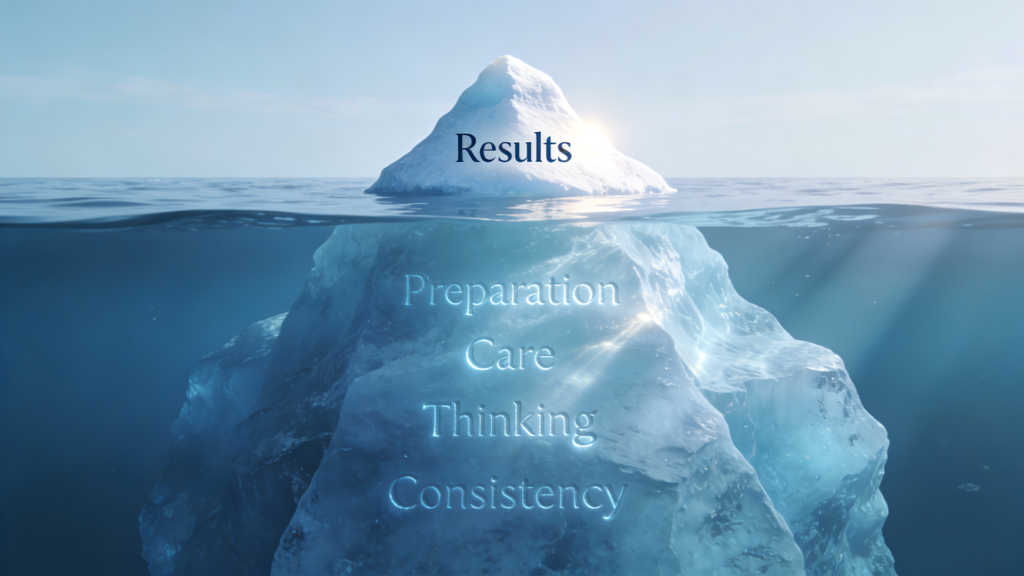
There is a type of work that rarely appears on dashboards. It does not always translate into immediate metrics. It is not celebrated in review meetings. And it often goes unnoticed unless something goes wrong. Yet, without it, systems falter, teams fracture, and progress slows. I am talking about invisible work.
After more than two decades in leadership roles, I have come to see that some of the most valuable contributions in an organization are also the least visible.
What invisible work looks like
Invisible work is not a role. It is a pattern of contribution. It looks like:
- anticipating problems before they escalate
- smoothing tension between teams quietly
- mentoring without formal responsibility
- holding context when others focus on tasks
- protecting timelines by absorbing ambiguity
- making decisions easier for others by doing extra thinking upfront
This work rarely gets applause. But it shapes outcomes in ways that are difficult to measure. And often, the people doing it question its value precisely because it is not easily seen.
Why invisible work often goes unrecognized
Most organizations reward what they can track. Revenue, delivery, output, or speed. Invisible work lives in the spaces between these metrics. It requires emotional intelligence. Systems thinking. Judgment. Restraint.
And because it prevents issues rather than producing tangible artifacts, it is often overlooked. The irony is that when invisible work stops happening, its absence becomes very visible.
The cost of ignoring invisible work
When invisible work goes unrecognized, two things happen.
First, people doing this work burn out quietly. They carry more than their share, often without acknowledgement, until the emotional weight becomes too heavy.
Second, organizations lose stability. Knowledge walks out the door. Context disappears. Problems begin surfacing that were previously handled before becoming visible.
What looks like sudden dysfunction is often the result of invisible work being taken for granted.
Why high performers are especially prone to invisible work
High performers tend to step in where gaps exist. They see what needs to be done and do it.
They care about outcomes beyond their job description. They value collective success. Over time, this becomes expected rather than exceptional. And because they continue delivering, their invisible contributions become assumed rather than appreciated.
This is not a failure of intention. It is a failure of awareness.
Recognizing the value of your own invisible work
One of the hardest parts of invisible work is recognizing its value yourself. When your contribution does not come with clear validation, it is easy to assume it does not matter. But value is not determined by visibility. Ask yourself:
- What problems do I regularly prevent?
- Whose work becomes easier because of my involvement?
- What context do I hold that others rely on?
- What decisions benefit from my judgment even if my name is not attached?
These questions help you see the impact that metrics may miss.
Making invisible work more visible without self-promotion
Recognition does not require self-promotion. It requires articulation. Here are a few ways to bring clarity to invisible contributions:
1. Name the work during reflections
During reviews or retrospectives, describe how outcomes were achieved, not just what was delivered. Context matters.
2. Share patterns, not credit
Instead of saying, “I handled this,” say, “What helped here was early alignment and ongoing communication.” This highlights the work without centering yourself.
3. Document decisions and thinking
Written context creates visibility. It allows others to see the reasoning behind outcomes.
4. Set boundaries around overextension
Invisible work should not mean unlimited availability. Boundaries protect sustainability.
For leaders: learning to notice what isn’t loud
Leaders play a critical role in recognizing invisible work. This requires attention beyond outputs. Look for:
- who carries the emotional load
- who mediates conflict
- who anticipates issues
- who supports others consistently
Recognition does not always need to be public. But it must be genuine. People stay where their effort is understood.
Invisible work builds visible impact over time
The effects of invisible work compound. Teams function better. Decisions improve. Trust grows. Culture stabilizes. These outcomes do not happen by accident.
They are built by people who care deeply about the work and the people around them.
A personal reflection
There were years in my own career when much of what I did felt invisible. I knew it mattered. Others benefited from it. But it rarely came up in formal conversations. What helped was learning to value that work internally first. To understand that not all impact arrives with recognition.
At the same time, I learned to speak about my contributions with clarity, not apology. Both are necessary.
The balance between contribution and sustainability
Invisible work should not require self-erasure. Your value does not increase when you exhaust yourself. Recognizing your impact also means choosing where to invest your energy intentionally. Not every gap needs to be filled by you. Not every silence needs your intervention.
Resilience in work comes from knowing when to step in and when to step back.
Closing thought
If you have ever felt that your work goes unnoticed, pause before questioning your worth. Invisible does not mean insignificant. The impact you create may not always be immediate or measurable, but it is real, and over time, it shapes outcomes more powerfully than visibility ever could.
Recognize the value you bring. Articulate it when needed. Protect it where necessary because sustainable impact depends not just on what is seen, but on what is quietly held together every day.


Social Profiles