

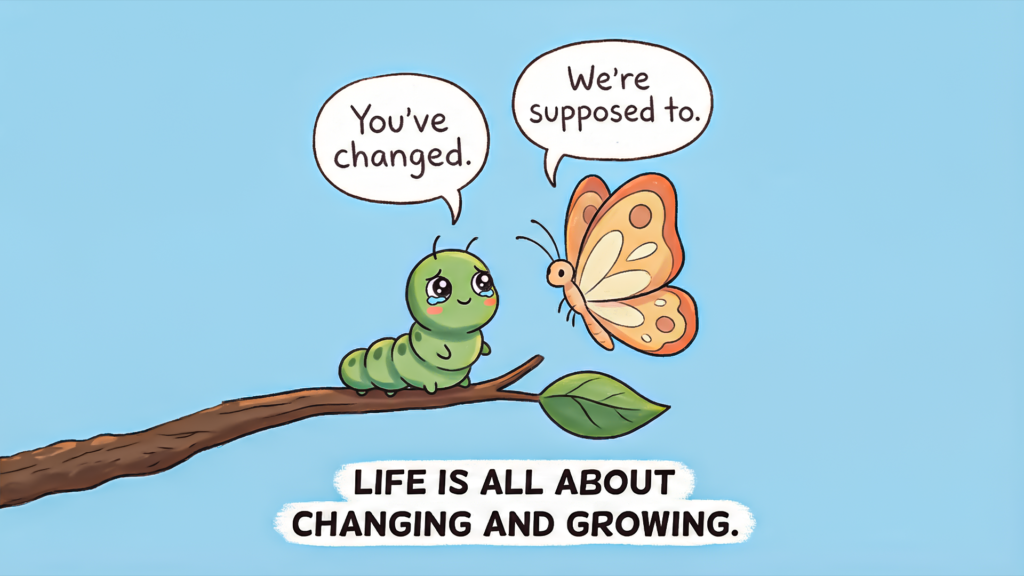
There is a quiet grief that comes with growth. Not the kind that announces itself loudly but the kind that sits gently in the background. The kind you notice when something that once felt right no longer does. It is not because you have failed or have changed for the worse. You have simply outgrown a version of yourself.
Yet, guilt often follows.
Why?
When you evolve, it can feel as though you are abandoning who you once were.
The version that coped the best it could, made sense of the world with limited tools, survived difficult seasons, and held on when things were uncertain. There is loyalty attached to that version. So when you begin to move differently, want different things or feel less connected to old patterns, guilt creeps in.
How can I let go of who I was when she carried me through so much?
Growth doesn’t erase your past self
Outgrowing a version of yourself does not mean rejecting it. It means recognising that what once kept you safe may no longer be what helps you thrive. The boundaries you built. The habits you relied on. The ways you protected your heart. They were necessary once.
They don’t need to follow you forever.
Then why this feeling of guilt? Guilt often appears when growth threatens familiarity. You may feel guilty for:
- Changing your mind
- Wanting more ease
- Choosing differently than before
- Letting go of identities that once defined you
But guilt is not a sign that you are wrong. It is often a sign that you are stepping into unfamiliar emotional territory.
The version of you that survived is not the version that must stay
Survival versions of ourselves are powerful. They are resilient, resourceful and strong. But survival is not meant to be permanent. If you remain in survival mode long after the danger has passed, life begins to feel heavy, restricted and guarded.
Outgrowing survival does not dishonour it. It completes it. What you wanted at one point in your life made sense then. You needed approval, structure, certainty, and validation.
As you grow, your nervous system changes. Your awareness deepens. Your needs shift. Wanting something different now is not inconsistent; it is responsiveness.
How do you let go?
Sometimes the hardest thing to release is not a person or a situation, but an identity. The strong one, the fixer, the one who never needs help or the one who keeps going no matter what. These identities once served you, but they can become cages if you never allow yourself to step outside them.
Outgrowing an identity can feel like losing yourself. In reality, it is often how you find yourself again.
Why do we cling to old versions
We cling because:
- They are familiar
- They are predictable
- They helped us belong
- They explain who we are
Letting go introduces uncertainty.
Who am I without this role? How will I be seen? Will I still be accepted? These questions are tender. They deserve compassion, not pressure.
Here is the catch: You can honour who you were without staying there. There is a way to look back without being pulled backwards.
You can say:
Thank you for protecting me.
Thank you for carrying me through.
Thank you for doing the best you could.
And then gently say: I don’t need you to lead anymore.
This is not rejection. It is evolution.
Guilt softens when you replace judgment with understanding
Instead of asking: Why am I like this now? Try asking: What has changed within me? Curiosity softens guilt.
Understanding replaces shame. You begin to see growth as a natural unfolding, not a moral failure. You don’t lose the wisdom of your past selves.
You carry their insight, their empathy and their strength. What changes is how tightly those traits hold you. You get to choose which parts move forward with you.
There were versions of me I held onto far longer than necessary.
Tired versions.
Overly accommodating versions.
Versions that believed safety came from shrinking.
Letting them go felt uncomfortable, almost disloyal. But when I finally allowed myself to change, something unexpected happened.
Relief.
Not because those versions were wrong, but because they were no longer needed.
If you feel guilty for changing
If guilt is present, pause before trying to get rid of it. Ask:
- What am I afraid of losing?
- What am I afraid others will think?
- What part of me is asking for permission?
Often, guilt is just a younger part of you seeking reassurance. Offer it gently.
You don’t owe consistency to anyone at the cost of your growth. You are allowed to change your values.
Your boundaries. Your pace. Your priorities. Consistency is not the same as integrity.
Integrity is living in alignment with who you are now.
Outgrowing is not something you do once
Growth happens in layers. You may outgrow many versions of yourself over a lifetime.
Each time, there may be discomfort.
Each time, there may be grief.
Each time, there may be guilt.
And each time, there is also expansion. Outgrowing versions of yourself is not something to apologise for. It is evidence that you are listening to your inner life.
You are not abandoning who you were. You are integrating them.
Let guilt soften.
Let gratitude remain.
Let yourself keep growing.
You are allowed to become someone new without carrying old versions of yourself as a burden. And that, too, is healing.


Social Profiles