

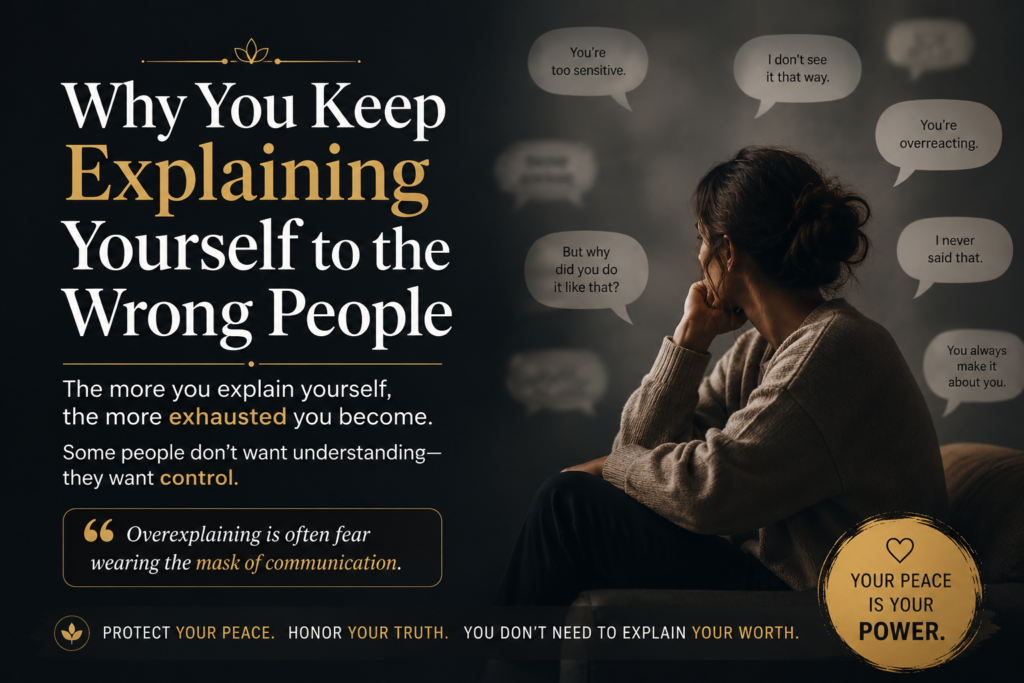
The more you explain yourself, the more exhausted you become.
Not because your feelings are invalid.
Not because your reasons don’t make sense.
But because deep down, you are trying to earn understanding from people who have already decided not to see you clearly.
And that kind of explaining is not communication.
It’s emotional survival.
You Think If You Explain Better, You’ll Finally Be Understood
So you keep trying.
You clarify your intentions.
You overexplain your decisions.
You replay conversations in your head, wondering if you used the wrong words.
You tell yourself:
- “Maybe I didn’t explain it properly.”
- “Maybe if they understood my side…”
- “Maybe I just need to say it differently.”
But here’s the painful truth:
Some people are committed to misunderstanding you because it benefits their comfort.
And no amount of explaining can force emotional maturity into someone who refuses self-awareness.
Overexplaining Usually Starts as a Protection Pattern
Most people don’t overexplain because they love talking.
They overexplain because somewhere along the way, they learned:
- Their feelings would be questioned
- Their needs needed justification
- Their boundaries would be challenged
- Their “no” would not be accepted easily
So they adapted.
They learned to:
- Add extra detail
- Soften their truth
- Justify every decision
- Make themselves easier to accept
Not because they were dishonest.
Because they were trying to stay emotionally safe.
You Are Not Meant to Convince Everyone
This is the part many people struggle to accept.
Not everyone will understand you.
Not everyone will agree with you.
Not everyone will see your heart accurately.
And that does not mean you are wrong.
Sometimes, people misunderstand you because:
- They only understand relationships built on control
- Your boundaries inconvenience them
- Your growth no longer fits their expectations
- They are listening to defend themselves, not understand you
In these situations, explaining becomes endless.
Because the issue is not clarity.
The issue is willingness.
The Need to Be Understood Can Become Self-Abandonment
Read that again.
When you constantly explain yourself to people committed to misunderstanding you, something dangerous happens:
You stop protecting your peace and start performing for approval.
You begin:
- Doubting your own decisions
- Defending boundaries that should simply be respected
- Shrinking your truth to avoid conflict
- Seeking validation instead of trusting yourself
And slowly, you lose connection with your own clarity.
Healthy People Don’t Require Endless Justification
This is important.
Emotionally healthy people may not always agree with you.
But they respect your humanity.
They listen.
They ask questions.
They try to understand without constantly making you prove your worth.
You do not have to write emotional essays
for people who genuinely care about you.
Not Every Conversation Deserves Your Energy
Some people ask questions to understand you.
Others ask questions to challenge, control, or exhaust you.
Learn the difference.
Constantly explaining yourself to emotionally unavailable people will drain your confidence over time.
Not every misunderstanding needs correction.
Not every opinion deserves access to your inner world.
Sometimes peace sounds like:
“This is my decision.”
“This is what feels right for me.”
“I don’t need to explain this further.”
Why Silence Feels So Uncomfortable
If you are used to overexplaining, silence may feel rude at first.
You may feel guilty.
Selfish.
Cold.
But often, that discomfort comes from conditioning—not truth.
You were taught that your boundaries needed permission.
That your choices needed approval.
They don’t.
You are allowed to make decisions without emotionally defending your existence.
A Personal Realisation
There was a time when I explained everything.
My boundaries.
My choices.
My feelings.
I believed if I communicated carefully enough, everyone would understand me.
But some people didn’t want understanding.
They wanted access. Control. Agreement.
The shift happened when I realised:
Clarity is enough.
Overexplaining is often fear wearing the mask of communication.
And once I stopped trying to convince everyone,
I felt lighter.
More peaceful.
More certain within myself.
A Closing Truth
You do not need to exhaust yourself proving your heart to people committed to misunderstanding it.
The right people will not require constant explanation to respect you.
You are allowed to choose yourself without writing a defense statement for it.
Powerful CTA
The next time you feel the urge to overexplain, pause.
Ask yourself:
“Am I communicating…
Or am I trying to earn permission to be understood?”
Then breathe.
And remember:
Not everyone deserves full access to your emotional energy.
Sometimes the strongest thing you can say is:
“This is what’s true for me.”


Social Profiles