

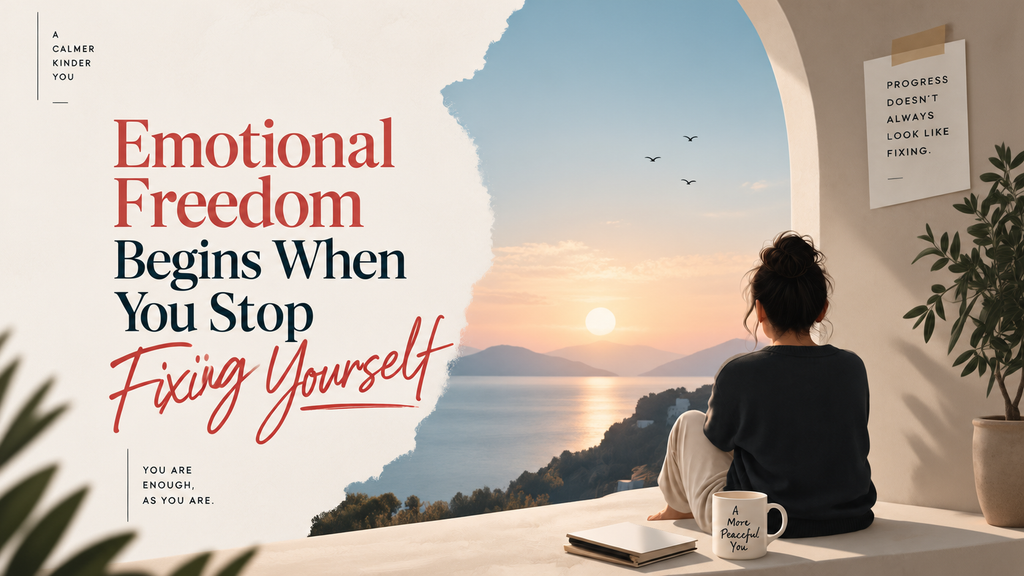
Written from the heart by Ruchi Rathor
Life Coach | Helping You Lead From Within
“You were never a broken person waiting to be fixed. You were a human being waiting to be understood.”
How often have you looked at yourself and thought:
I need to become less emotional.
I need to stop overthinking.
I need to be more confident.
I need to stop caring so much.
I need to heal this part of me.
I need to become better.
We are surrounded by messages telling us to improve ourselves.
Become stronger.
Become calmer.
Become more productive.
Become more confident.
Become the best version of yourself.
Growth is beautiful.
But there is a quiet danger when growth becomes a constant attempt to escape the person you are today.
Because sometimes, beneath the desire to improve ourselves is a deeper belief:
“Who I am right now is not enough.”
And that belief can turn healing into another form of self-rejection.
When Healing Becomes Another Way of Criticising Yourself
There is a difference between wanting to grow and believing you are unacceptable until you do.
One comes from love.
The other comes from shame.
When you approach yourself with the belief that something is fundamentally wrong with you, every difficult emotion becomes evidence.
You get angry and think, “I haven’t healed enough.”
You make a mistake and think, “Why am I still like this?”
You feel insecure and think, “I should be beyond this by now.”
You have a difficult day and immediately begin searching for what needs to be fixed.
Slowly, healing becomes another performance.
Another checklist.
Another destination you must reach before you can finally feel worthy of peace.
But self-compassion research points toward a different relationship with ourselves: one grounded in kindness and acceptance rather than constant self-judgment.
You don’t heal by becoming someone you can finally tolerate.
You heal by learning to stay with yourself—even when you’re imperfect.
You Are Not a Project
Imagine speaking to a friend the way you sometimes speak to yourself.
“Why are you still struggling with this?”
“You should have figured this out by now.”
“Why can’t you just get over it?”
“What’s wrong with you?”
Would you call that encouragement?
Probably not.
Yet many of us have turned this harsh inner voice into our primary motivator.
We believe criticism keeps us moving.
We believe pressure makes us better.
We believe being hard on ourselves prevents us from becoming complacent.
But growth does not require you to be at war with yourself.
You are allowed to grow without treating yourself as a problem.
Self-Acceptance Does Not Mean Giving Up
This is where many people misunderstand acceptance.
They think:
“If I accept myself as I am, won’t I stop growing?”
No.
Acceptance is not saying:
“I don’t need to change anything.”
It is saying:
“I don’t need to hate myself in order to change.”
You can accept that you overthink and still learn to become more present.
You can accept that you struggle with boundaries and still learn to say no.
You can accept that you have made mistakes and still make different choices.
You can acknowledge your wounds without making them your identity.
Self-compassion is not the absence of growth; research suggests it can coexist with motivation and personal standards rather than undermining them.
The difference is in the energy behind the change.
“I am not enough, so I must change” creates pressure.
“I love myself enough to care for what needs attention” creates possibility.
Stop Asking, “What’s Wrong With Me?”
This one question can change the way you relate to yourself.
Instead of:
“What’s wrong with me?”
Try:
“What is happening inside me?”
Instead of:
“Why am I so sensitive?”
Ask:
“What is this sensitivity trying to tell me?”
Instead of:
“Why can’t I let this go?”
Ask:
“What part of me still needs care?”
Instead of:
“Why am I reacting like this?”
Ask:
“What might this reaction be protecting?”
These questions don’t excuse unhealthy behaviour.
They create space for understanding.
And understanding gives you something criticism never can:
a place to begin.
Your Difficult Emotions Are Not Proof That You Are Failing
You will still have days when you feel overwhelmed.
You will still become impatient.
You will still doubt yourself sometimes.
You may still return to old patterns when life becomes difficult.
That doesn’t mean you’ve gone backwards.
It means you’re human.
Healing is not the elimination of every uncomfortable emotion.
It is developing a different relationship with those emotions.
You notice them.
You listen.
You respond.
You learn.
And you continue.
There is a profound difference between:
“I shouldn’t feel this.”
and
“I feel this. What do I need right now?”
The second question creates compassion.
And compassion creates room.
Sometimes the Part You Want to Fix Needs to Be Heard
Think about the part of yourself you dislike the most.
The part that gets anxious.
The part that needs reassurance.
The part that becomes defensive.
The part that struggles to trust.
The part that keeps replaying the past.
Instead of immediately trying to silence it, sit with it.
Ask:
“When did you learn to behave this way?”
“What were you trying to protect me from?”
“What do you need from me now?”
You may discover that the behaviour you judge today once served a purpose.
It helped you cope.
It helped you survive.
It helped you navigate something you didn’t yet know how to handle.
You don’t have to keep the pattern.
But you can stop hating the part of you that learned it.
Emotional Freedom Is Not Feeling Good All the Time
We sometimes imagine freedom as constant peace.
No anxiety.
No sadness.
No anger.
No fear.
But emotional freedom is something deeper.
It is being able to experience an emotion without immediately becoming defined by it.
You can say:
“I am having a difficult day, but I am not a difficult person.”
“I feel rejected, but I am not unworthy.”
“I made a mistake, but I am not a failure.”
“I am afraid, but I can still choose my next step.”
Your emotions can be real without becoming your identity.
That is freedom.
You Don’t Need to Become Your “Best Version” Every Day
Some days you will be productive.
Some days you will simply get through the day.
Some days you’ll feel deeply connected to yourself.
Other days, you’ll feel lost.
Some days you’ll make beautiful choices.
Other days you’ll learn from choices you wish you had made differently.
Let yourself be human across all of them.
Your worth should not fluctuate with your performance.
You don’t become more deserving on your best days.
And you don’t become less deserving on your worst ones.
You are still you.
A Personal Reflection
There was a time when I believed personal growth meant constantly correcting myself.
If something hurt, I wanted to understand it immediately.
If I reacted emotionally, I wanted to fix the reaction.
If I made a mistake, I wanted to become better before permitting myself to move forward.
But slowly, I began to understand something.
I was spending so much energy trying to become a better version of myself that I wasn’t fully accepting the version standing in front of me.
The shift came when I stopped asking:
“How can I fix myself?”
and started asking:
“How can I understand myself better?”
That question softened something inside me.
I became less interested in perfection.
More interested in presence.
Less afraid of my emotions.
More willing to listen to them.
And I realised that perhaps healing was never about becoming someone else.
It was about coming home to myself.
Growth Can Begin From Love
You don’t have to hate your current life to want something different.
You don’t have to hate your body to care for it.
You don’t have to hate your personality to develop new habits.
You don’t have to hate your past to create a different future.
Change becomes more sustainable when it comes from care rather than contempt.
Instead of:
“I need to fix myself.”
Try:
“I want to take better care of myself.”
That is a completely different relationship with growth.
One is punishment.
The other is love.
A Closing Reflection
Perhaps the deepest healing begins when you stop treating yourself like a problem that needs solving.
You are allowed to have unfinished parts.
You are allowed to be learning.
You are allowed to carry contradictions.
You are allowed to change slowly.
You are allowed to have difficult emotions without judging yourself for having them.
And you are allowed to want more for yourself without believing that what you have today is not enough.
You don’t have to become perfect to become free.
You don’t have to erase every wound.
You don’t have to silence every fear.
You don’t have to fix every part of yourself.
Sometimes freedom begins with something much simpler:
“I am here. I am human. I am still learning. And I am worthy of compassion while I do.”
That is not giving up on yourself.
That is finally choosing yourself.
Your Gentle Practice This Week
The next time you catch yourself thinking,
“I need to fix this about myself,”
pause.
Place your hand on your heart and ask:
“What if this part of me doesn’t need punishment? What if it needs understanding?”
Write down what comes up.
Don’t correct it.
Don’t judge it.
Just listen.
Because sometimes the part of you you’ve spent years trying to change…
is the part that has been waiting the longest to be loved. 🤍


Social Profiles