
For many years, I believed emotions were something to manage, control and regulate. To keep in check so they wouldn’t interfere with life. I knew how to function. I knew how to show up. I knew how to keep going even when something felt off inside. What I didn’t know was how to listen. Because emotions are not noise. They are a language. And like any language we were never taught, we misinterpret it, ignore it, or silence it altogether.
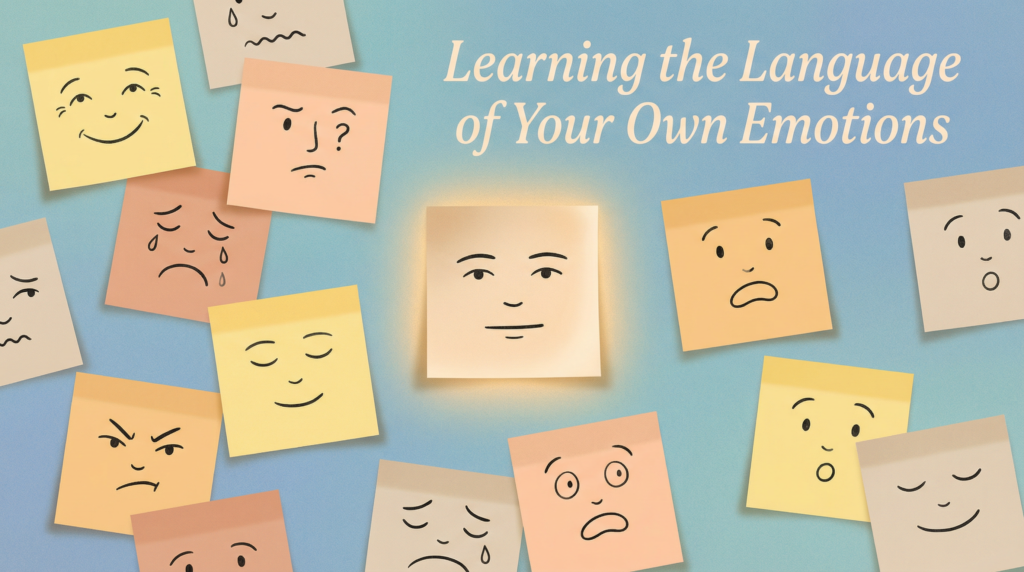
Most of us were never taught emotional fluency
Growing up, many of us learned how to name only a handful of emotions.
Happy.
Sad.
Angry.
Fine.
Everything else got compressed into these few words. Discomfort became “I’m okay.” Overwhelm became “I’m tired.” Grief became “I don’t want to talk about it.” We learned early that clarity of emotion was not always welcomed. That some feelings made others uncomfortable. That moving on was more valued than understanding. So we adapted.
We learned how to live around our emotions instead of with them.
What happens when you don’t understand your emotional language
When emotions are not understood, they don’t disappear. They find other ways to express themselves. They show up as:
- Irritability without a clear cause
- Constant fatigue
- Overthinking
- Emotional numbness
- Sudden tears that feel disproportionate
- Withdrawal from things that once mattered
Often, the problem is not that we feel too much. It’s that we don’t know what we’re feeling. And confusion is far more exhausting than emotion itself.
Emotions are signals, not interruptions
We are taught to see emotions as interruptions to productivity, relationships, and decision-making. But emotions are information. They tell you:
- When something matters
- When a boundary has been crossed
- When you feel unsafe
- When you are longing for connection
- When you are out of alignment
Ignoring emotions is like ignoring a language you don’t understand. The message keeps coming, just louder and more distorted each time. Learning the language of your emotions is not about indulgence. It is about literacy.
Naming creates space
One of the most powerful shifts happens when you learn to name what you feel accurately. Not just “upset,” but disappointed. Not just “anxious,” but uncertain. Not just “angry,” but hurt. Naming an emotion does not amplify it. It grounds it. When you name a feeling, you stop being consumed by it. You create space between yourself and the experience.
You move from I am the emotion to I am experiencing the emotion. That distinction changes everything.
Why emotions feel overwhelming before they feel clear
Emotions often feel overwhelming when they are unnamed. Imagine hearing a sound repeatedly without knowing where it’s coming from. The mystery is what creates anxiety. Once you identify the source, the fear reduces. Similarly, when you cannot articulate what you feel, your body carries the weight of interpretation.
Learning emotional language gives your nervous system relief.
Listening instead of analysing
Many of us approach emotions with analysis. Why do I feel this way? What caused this? How do I make it stop? But emotions are not problems to solve. They are experiences to understand. Listening looks different. It sounds like:
- What is this feeling asking for?
- Where do I feel this in my body?
- What happens if I don’t rush to change it?
Listening slows you down. And in that slowing, emotions soften.
Your emotions have patterns
When you begin paying attention, you will notice that certain emotions show up repeatedly in similar situations. You may feel small in certain spaces. Anxious before certain conversations. Disconnected after certain interactions. These patterns are not random. They are communicating. Your emotions are trying to show you where something needs attention. Not judgment but attention.
Emotional language is deeply personal
There is no universal dictionary for emotions. What sadness feels like to you may feel different to someone else. What safety means to you may not look the same for another person. This is why comparison rarely helps emotional growth. Learning your emotional language means noticing:
- How your body responds
- What emotions follow which experiences
- What you suppress instinctively
- What you allow yourself to feel freely
This awareness builds intimacy with yourself.
You don’t need to express everything to everyone
Learning your emotional language does not mean constant sharing. Some emotions are meant to be processed privately. Some with trusted people. Some simply acknowledged internally. Emotional fluency gives you choice. You decide:
- What to share
- When to share
- With whom
Silence becomes intentional instead of suppressive.
A personal realisation
There was a time when I thought I was emotionally stable because I didn’t react much. I stayed calm. I stayed composed. I stayed reasonable. But underneath that composure was avoidance. I wasn’t fluent. I was disconnected. It took time to realise that feeling deeply was not the problem. Not understanding what I felt was. Learning to listen changed my relationship with myself. It made me gentler. More patient. Less reactive. Not because I felt less. But because I understood more.
Building emotional vocabulary is an act of care
Every time you pause to ask, What am I really feeling right now? You practice self-care. Not the performative kind. The quiet kind. This care does not make life easier overnight. But it makes it more honest. And honesty creates relief.
If this feels unfamiliar
If you feel disconnected from your emotions, that does not mean you are broken. It means you adapted. Adaptation kept you safe once. Awareness will help you grow now. You do not have to rush this process. You do not have to get it right. You do not have to feel everything all at once. Learning a language takes time, and this one is worth learning.
A closing reflection
Your emotions are not trying to control you. They are trying to communicate with you. When you learn their language, you stop fighting yourself. You begin relating to yourself, and that relationship becomes the foundation for everything else.


Social Profiles