

Written from the heart by Ruchi Rathor
Life Coach | Helping You Lead From Within
“The world will applaud you for moving faster. Your soul will thank you for slowing down.”
Somewhere along the way, we started believing that a busy life is a meaningful life.
If your calendar is full, you must be successful.
If you’re constantly available, you must be committed.
If you’re always doing something, you must be productive.
So we rush.
We eat while answering emails.
We listen without really hearing.
We rest with guilt.
We celebrate being “busy” as though exhaustion has become a badge of honor.
Then one day, we wonder why we feel disconnected from ourselves.
The truth is, the problem isn’t that we’re doing too little.
It’s that we’re moving through life too quickly to experience it.
And perhaps the greatest misunderstanding of our time is this:
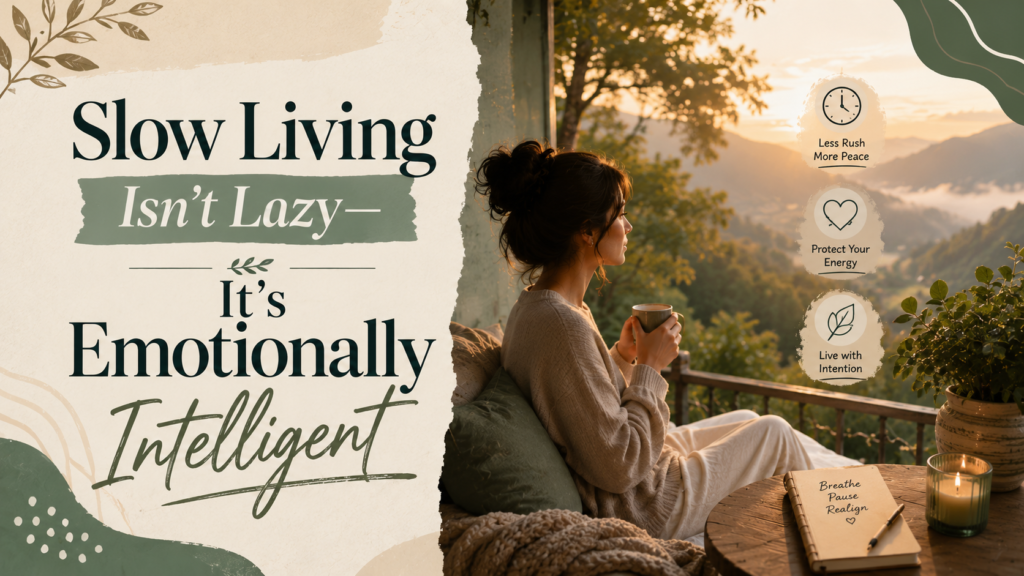
Slow living is not laziness. It’s emotional intelligence in action.
We’ve Confused Speed with Success
Modern life rewards urgency.
Quick replies.
Instant decisions.
Nonstop productivity.
We’re praised for multitasking, staying available, and pushing through fatigue.
The message is subtle but constant:
“Keep going.”
“Don’t stop.”
“You can rest later.”
But emotional intelligence asks a different question.
“What is the cost of never slowing down?”
Because when life becomes a race, we stop noticing how we actually feel.
We become efficient at completing tasks…
but disconnected from our own inner world.
Moving Fast Doesn’t Always Mean Moving Forward
There is a difference between progress and constant motion.
You can spend an entire day rushing from one responsibility to another and still feel unfulfilled.
Why?
Because movement without awareness isn’t growth.
It’s momentum.
Many people aren’t tired because they’re doing too much.
They’re tired because they’ve been living on autopilot for too long.
Without pausing to ask:
“Is this pace still serving me?”
Your Nervous System Wasn’t Designed for Constant Urgency
Our bodies are incredibly wise.
They know the difference between healthy effort and endless pressure.
When you’re always rushing, your nervous system begins to believe that life is one long emergency.
Your breathing becomes shallow.
Your mind becomes noisy.
Your patience becomes shorter.
Even moments of rest feel uncomfortable because your body has forgotten how to slow down.
This isn’t a lack of discipline.
It’s a lack of recovery.
And without recovery, even beautiful lives begin to feel heavy.
Slow Living Is About Presence, Not Productivity
Many people imagine slow living as doing less.
But that’s only part of the story.
Slow living isn’t about escaping responsibility.
It’s about bringing your full presence to the life you’re already living.
It means:
Eating without rushing.
Listening without planning your next response.
Walking without checking your phone every few minutes.
Working with intention instead of constant urgency.
Ending the day without feeling like you were racing against time.
The goal isn’t to slow your life.
The goal is to stop rushing through it.
Emotionally Intelligent People Know When to Pause
One of the greatest signs of emotional intelligence isn’t knowing all the answers.
It’s knowing when to pause before reacting.
To notice your emotions before they become actions.
To recognize exhaustion before it becomes burnout.
To honor your limits before your body is forced to create them.
Pausing isn’t weakness.
It’s wisdom.
Because every thoughtful response begins with enough space to choose it.
The Fear of Slowing Down
For many people, slowing down feels uncomfortable.
Not because they enjoy being busy.
Because busyness protects them from themselves.
When life becomes quiet…
Unprocessed emotions begin to surface.
Grief asks to be felt.
Loneliness asks to be acknowledged.
Dreams you’ve ignored begin knocking on the door.
Silence has a way of revealing what constant movement allows us to avoid.
And that’s why slowing down can feel frightening.
Not because stillness is dangerous.
Because it is honest.
Small Moments of Slowness Change Everything
You don’t need to move to the mountains.
You don’t need to quit your job.
You don’t need an entirely different life.
Slow living begins with ordinary moments.
Taking three deep breaths before opening your laptop.
Watching the sunrise instead of reaching for your phone.
Sitting with a cup of tea without multitasking.
Finishing one conversation before starting another.
Permitting yourself to do one thing well instead of five things hurriedly.
These moments seem small.
But they quietly retrain your nervous system to believe:
Life is not an emergency.
A Personal Reflection
There was a time when I believed that slowing down meant falling behind.
My days were filled with meetings, responsibilities, and endless to-do lists.
Even when I rested, my mind kept working.
I thought being constantly busy meant I was making the most of life.
But one day, I realized something surprising.
I was moving so quickly that I wasn’t actually experiencing the life I was working so hard to build.
So I began making small changes.
I stopped rushing every conversation.
I started protecting quiet moments in my day.
I learned to pause before saying yes to everything.
And slowly, something shifted.
I didn’t become less productive.
I became more present.
More peaceful.
More connected to myself.
The Most Meaningful Life Isn’t the Fastest One
At the end of our lives, we probably won’t remember how quickly we answered emails.
Or how many tasks we completed in a single day.
We’ll remember the conversations where we were fully present.
The laughter we didn’t rush.
The sunsets we actually stopped to watch.
The people who felt deeply seen because we gave them our full attention.
Life isn’t measured by speed.
It’s measured by presence.
A Closing Reflection
You don’t have to earn rest by exhausting yourself first.
You don’t have to prove your worth through constant busyness.
You don’t have to rush through your days to justify your existence.
The life you’re trying so hard to build deserves to be experienced…
not just survived.
Because slowing down isn’t giving up.
It’s finally giving yourself the chance to notice what truly matters.
And that may be one of the most emotionally intelligent choices you’ll ever make.
Your Gentle Practice This Week
Choose one part of your day to do slowly.
Eat without distractions.
Take a walk without your phone.
Have one conversation without checking the time.
And as you do, ask yourself:
“What have I been moving too fast to truly notice?”
You may discover that the peace you’ve been searching for wasn’t waiting at the finish line.
It was waiting in the pause you kept postponing.


Social Profiles