

Written from the heart by Ruchi Rathor
Life Coach | Helping You Lead From Within
“Sometimes, you’re not working hard because you’re passionate. Sometimes, you’re working hard because being still would force you to feel what you’ve been avoiding.”
There is a version of productivity that looks incredibly impressive from the outside.
The early mornings.
The packed calendar.
The endless to-do lists.
The constant emails.
The projects.
The goals.
The achievement.
Everyone sees discipline.
Everyone sees ambition.
But sometimes, underneath all that doing, something much quieter is happening.
You are trying not to feel.
You stay busy because silence makes you uncomfortable.
You keep working because slowing down brings thoughts to the surface.
You take care of everyone else because it’s easier than asking what you need.
You keep achieving because accomplishment gives you temporary relief from emotions you don’t know how to hold.
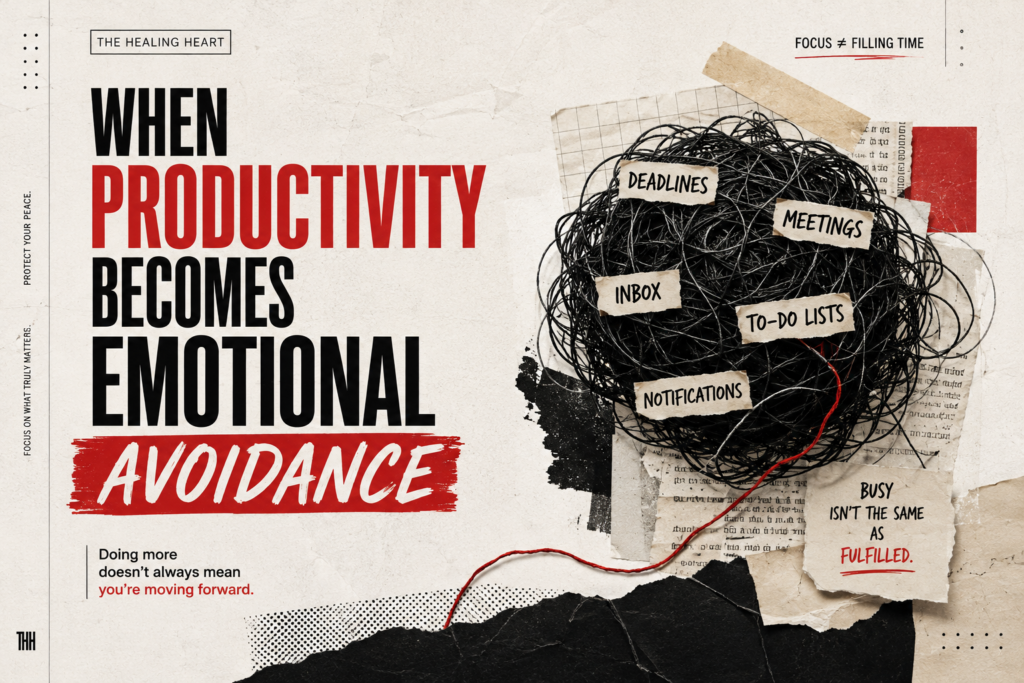
And this is where productivity can quietly become emotional avoidance.
When Doing Becomes a Way of Not Feeling
Productivity itself isn’t the problem.
Work can give us purpose.
Goals can give us direction.
Achievement can be deeply fulfilling.
The question is not:
“Am I productive?”
The deeper question is:
“What am I using productivity to avoid?”
Sometimes we’re working because something genuinely matters to us.
Other times, we’re working because we don’t want to sit with ourselves.
Research on busyness and emotional avoidance suggests that staying occupied can provide short-term relief from uncomfortable emotions, while leaving the underlying feelings unresolved.
That distinction matters.
Because what looks like motivation from the outside may sometimes be protection on the inside.
The Things You May Be Avoiding Without Realising It
Maybe it’s grief you’ve never allowed yourself to process.
Maybe it’s disappointment.
Maybe it’s loneliness.
Maybe it’s anger you don’t know what to do with.
Maybe it’s the uncomfortable truth that a relationship, career, or lifestyle no longer feels aligned.
So instead of feeling it…
you do.
You clean.
You organise.
You answer emails.
You take another meeting.
You start another project.
You help someone else.
You create another goal.
And for a while, it works.
Because activity gives the mind somewhere else to go.
But eventually, the quiet returns.
And so does the feeling.
Why Productivity Feels Safer Than Emotion
There is something comforting about a task.
A task has instructions.
A deadline.
An outcome.
A beginning and an end.
Emotions are different.
You cannot always schedule grief between 2:00 and 3:00.
You cannot put uncertainty on a checklist.
You cannot complete sadness and move on to the next task.
So when emotions feel messy, productivity can feel like control.
You may not know how to solve what is happening inside you…
but you know how to answer an email.
You know how to finish a report.
You know how to organise your calendar.
Work gives you something concrete to control when your inner world feels uncertain.
When Achievement Becomes Emotional Validation
There is another layer.
Sometimes, we don’t just use productivity to avoid emotions.
We use it to prove something.
That we’re capable.
That we’re successful.
That we’re valuable.
That we’re not falling behind.
That we’re worthy of recognition.
So every completed task becomes a tiny reassurance:
“I’m doing okay.”
But when your sense of worth depends heavily on output, rest can feel threatening.
Because if you’re not achieving…
Who are you?
That is a difficult question.
And sometimes, we stay busy simply because we don’t want to answer it.
The Most Productive Person in the Room May Also Be the Most Exhausted
This is why we have to be careful about glorifying constant productivity.
A person can be highly accomplished and deeply disconnected from themselves.
They can meet every deadline while ignoring their emotional needs.
They can support everyone around them while never asking for support.
They can look incredibly successful while quietly running on emotional exhaustion.
Being capable does not make you immune to avoidance.
Sometimes, your ability to keep functioning is exactly what allows you to avoid noticing that something inside you needs attention.
The Moment You Stop, Everything You Avoided Can Catch Up
Have you ever noticed that difficult thoughts seem louder at night?
Or on weekends?
Or during holidays?
Or when your calendar suddenly becomes empty?
That’s not necessarily because something became worse.
Sometimes, there is simply less noise covering it.
When you stop moving, your inner world becomes easier to hear.
And that can feel uncomfortable.
But discomfort isn’t always something to escape.
Sometimes it is information.
Your sadness may be asking to be acknowledged.
Your exhaustion may be asking for rest.
Your resentment may be pointing toward a boundary.
Your anxiety may be revealing uncertainty you haven’t allowed yourself to face.
Your emotions are not interruptions.
They are messages.
Productivity Should Support Your Life, Not Help You Escape It
There is nothing wrong with ambition.
There is nothing wrong with working hard.
There is nothing wrong with wanting more from yourself or your life.
The shift happens when achievement stops being an expression of who you are…
and becomes a way to avoid who you are.
Healthy productivity asks:
“What matters?”
Emotional avoidance asks:
“What can I do so I don’t have to feel this?”
They may look identical from the outside.
But internally, they lead to completely different lives.
Learn to Notice the Difference
Before starting another task, pause for a moment.
Ask yourself:
Am I doing this because it matters—or because I don’t want to be still?
When you feel the urge to fill every empty moment, notice it.
When rest makes you anxious, notice it.
When you suddenly need to reorganise your entire life because you’re emotionally uncomfortable, notice it.
You don’t need to judge yourself.
You don’t need to stop being productive.
You simply need to become honest about why you’re doing what you’re doing.
Permit Yourself to Feel Without Fixing
One of the hardest lessons in healing is learning that not every emotion needs an immediate solution.
Sometimes you simply need to sit with it.
Say:
“I’m sad today.”
“I’m disappointed.”
“I’m overwhelmed.”
“I’m uncertain.”
“I don’t know what I need yet.”
There is tremendous power in allowing an emotion to exist without immediately turning it into a problem to solve.
Because when you stop fighting your emotions, they often stop demanding to be heard through exhaustion.
A Personal Reflection
There was a time when I thought being productive meant I was doing well.
If I had things accomplished, I felt in control.
If I had a full schedule, I felt useful.
If I was helping others, I didn’t have to think too much about myself.
But eventually, I realised something uncomfortable.
Some of my busiest moments were not my most purposeful ones.
They were simply the moments when I didn’t want to be alone with what I was feeling.
Learning to slow down taught me that productivity isn’t always the answer.
Sometimes the answer is a conversation.
Sometimes it is rest.
Sometimes it is grief.
Sometimes it is a boundary.
And sometimes…
it is simply allowing yourself to feel.
You Don’t Have to Earn Your Right to Rest
You are allowed to stop before everything is finished.
You are allowed to have an unproductive afternoon.
You are allowed to feel something without immediately fixing it.
You are allowed to exist without constantly improving yourself.
Your worth doesn’t rise with every completed task.
And it doesn’t disappear when you do nothing.
You are still enough when your calendar is empty.
A Closing Reflection
Maybe the goal isn’t to become less productive.
Maybe the goal is to become more emotionally honest.
To know when you’re working because you’re inspired…
and when you’re working because you’re afraid of what silence might reveal.
To know when you’re moving toward something…
and when you’re simply running away from something.
Because healing doesn’t always ask you to do more.
Sometimes, it asks you to stop long enough to finally hear yourself.
The task you’ve been avoiding may not be on your to-do list.
It may be the feeling you’ve been trying not to feel.
Your Gentle Practice This Week
The next time you feel the urge to immediately become busy, pause for five minutes.
Put the task aside.
Take a breath.
And ask yourself:
“What am I feeling right now that I would rather be productive than acknowledge?”
Don’t judge the answer.
Don’t fix it.
Just listen.
Because sometimes, the most courageous form of productivity…
is doing the inner work that no checklist can measure.


Social Profiles