

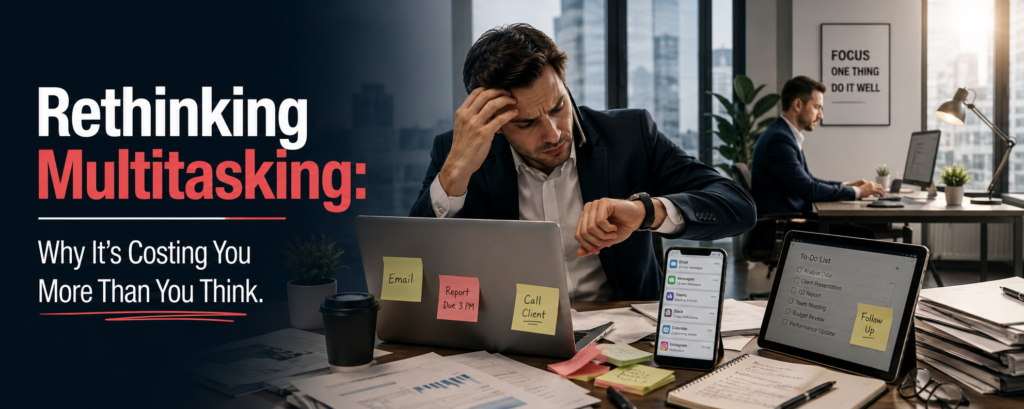
There was a time when multitasking felt like a badge of honor.
Replying to emails during meetings.
Checking messages while reviewing reports.
Taking calls while thinking about the next presentation.
The busier you looked, the more productive you seemed.
At least, that’s what many of us were taught to believe.
Modern work culture has quietly glorified the ability to do multiple things at once. We celebrate people who can juggle ten priorities, manage endless notifications, and respond instantly to every request.
But here’s the uncomfortable truth:
Being busy is not the same as being effective.
And multitasking may be costing you far more than you realize.
The Productivity Myth We’ve All Bought Into
Somewhere along the way, multitasking became synonymous with efficiency.
The logic appears simple:
If one task takes an hour, then doing two tasks simultaneously should save time.
But human attention doesn’t actually work that way.
What we call multitasking is often something else entirely.
Task-switching.
Your brain isn’t performing multiple complex activities simultaneously. Instead, it’s rapidly jumping from one task to another.
Email.
Presentation.
Message.
Meeting.
Spreadsheet.
Phone call.
Back and forth.
Every switch comes with a cost.
And those costs accumulate throughout the day.
The Hidden Price of Constant Switching
Imagine driving a car and changing direction every few seconds.
You would never build momentum.
The same thing happens with attention.
Every time you switch tasks, your brain must pause, refocus, and remember where it left off.
These transitions may seem small.
A few seconds here.
A minute there.
But over an entire day, they drain mental energy far more than most people realize.
The result?
You feel exhausted even when you haven’t completed meaningful work.
Not because you worked too hard.
Because your attention never had a chance to settle.
Why Leaders Are Especially Vulnerable
Leadership naturally involves multiple responsibilities.
People need answers.
Problems need solutions.
Decisions require attention.
As responsibilities grow, so does the temptation to multitask.
A leader might find themselves:
Reviewing reports during meetings.
Responding to messages while listening to a team member.
Thinking about tomorrow’s presentation while discussing today’s problem.
From the outside, it appears efficient.
But something important gets lost.
Presence.
And leadership without presence becomes management by distraction.
The Illusion of Accomplishment
One of the reasons multitasking is so addictive is that it creates the feeling of productivity.
You are constantly moving.
Constantly responding.
Constantly engaged.
The day feels full.
Yet at the end of it, many leaders ask themselves:
“What did I actually accomplish?”
This question matters.
Because activity and achievement are not the same thing.
Movement and progress are not identical.
A full calendar does not automatically create meaningful outcomes.
What Deep Thinking Requires
The most valuable leadership work rarely happens in rushed moments.
It happens when attention stays in one place long enough to see patterns.
Strategic decisions.
Creative problem-solving.
Vision.
Innovation.
These things require uninterrupted focus.
You cannot develop a breakthrough idea while checking notifications every few minutes.
You cannot fully understand a complex challenge while simultaneously answering emails.
Depth requires concentration.
And concentration requires protection.
The Impact on Decision-Making
Every decision consumes mental energy.
The more fragmented your attention becomes, the harder quality decision-making gets.
This is why leaders often feel mentally drained before the most important work even begins.
Their attention has already been spent on dozens of small interruptions.
By the time a significant decision arrives, their cognitive resources are depleted.
Not because the work was difficult.
Because distraction was expensive.
What Multitasking Does to Relationships
There is another cost that rarely gets discussed.
Connection.
People notice when you’re only partially present.
They notice when you’re checking emails while they’re speaking.
They notice when your attention is divided.
And over time, partial attention creates partial trust.
Employees want to feel heard.
Clients want to feel valued.
Relationships strengthen when people feel seen.
Multitasking often communicates the opposite.
Not intentionally.
But consistently.
Why Single-Tasking Feels Uncomfortable
Many professionals struggle with focused work because they have become accustomed to constant stimulation.
Notifications.
Updates.
Messages.
Alerts.
Silence starts to feel strange.
Focus starts to feel slow.
But that discomfort is often a sign that your brain is adjusting.
The ability to focus deeply is like a muscle.
It weakens when neglected.
And strengthens when practiced.
The Shift That Changed Everything
A lesson many leaders eventually learn is this:
Productivity is not about doing more things.
It is about doing important things more effectively.
This changes the question completely.
Instead of asking:
“How many tasks can I handle at once?”
Ask:
“Where does my attention create the most value?”
That shift transforms how work gets done.
Because attention is your most valuable resource.
Not time.
Not technology.
Attention.
Practical Ways to Break the Multitasking Habit
The solution isn’t becoming less productive.
It’s becoming more intentional.
A few simple changes can make a significant difference:
Schedule blocks of uninterrupted work.
Turn off non-essential notifications.
Close unnecessary tabs and applications.
Take notes during meetings instead of checking emails.
Focus on completing one meaningful task before moving to the next.
Protect thinking time as seriously as you protect meeting time.
These habits seem small.
But their impact compounds over time.
The Competitive Advantage of Focus
In a world where everyone is distracted, focus becomes rare.
And rare skills create extraordinary value.
The leaders who consistently make better decisions, generate stronger ideas, and create meaningful impact are not necessarily the smartest people in the room.
They are often the most focused.
They understand that attention is finite.
And they protect it accordingly.
A Closing Thought
Multitasking promises efficiency.
But often delivers exhaustion.
It promises speed.
But frequently creates mistakes.
It promises productivity.
But often prevents meaningful progress.
The goal isn’t to do everything.
The goal is to give your full attention to what matters most.
Because leadership is not measured by how many things you can juggle at once.
It is measured by the quality of attention you bring to the things that truly matter.
And in a world obsessed with doing more, the real advantage may be learning how to focus on less.
With clarity and intention,
Ruchi Rathor
Helping leaders lead with awareness, focus, and purpose.


Social Profiles