

For a long time, I confused being needed with being loved.
If people depended on me, I felt valuable.
If they came to me for solutions, I felt important.
If I were the one holding everything together, I believed I mattered.
So I became reliable.
I became available.
I became the person who fixed problems, carried responsibilities, and rarely asked for anything in return.
From the outside, it looked like strength.
But somewhere beneath all of that usefulness was a quiet question I never stopped asking:
“If I stopped doing all of this… would people still choose me?”
That question changed the way I understood relationships, leadership, and even my relationship with myself.
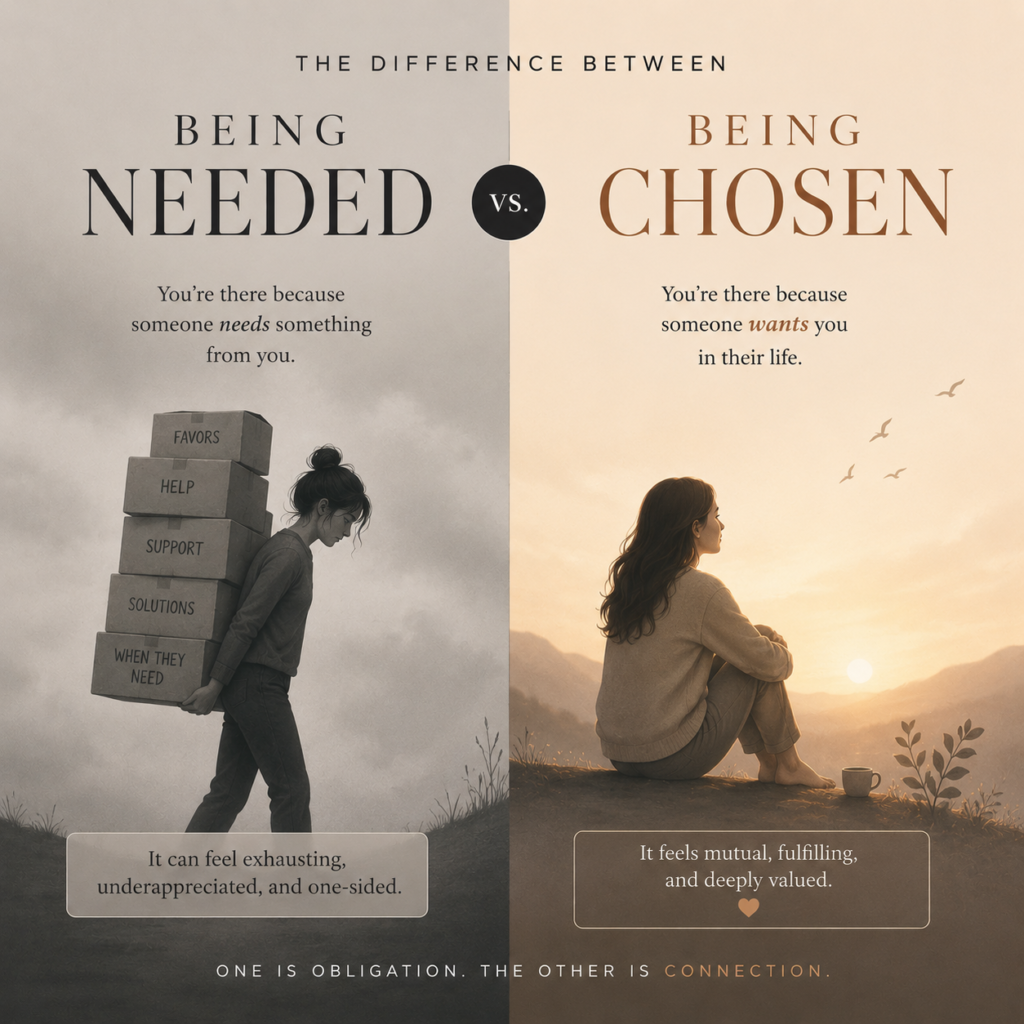
Being needed feels important
There is something deeply satisfying about being needed.
At work, it can look like being the person everyone calls during a crisis.
In friendships, it may look like always being the listener.
In families, it often becomes the role of the one who keeps everything running.
Need creates a sense of purpose.
People thank you.
They rely on you.
They make you feel indispensable.
But there is a hidden danger.
When your worth becomes tied to being useful, you start believing that your value exists only in what you provide.
You stop asking:
“Who am I without all these responsibilities?”
Being chosen is different
Being chosen is not about what you do.
It is about who you are.
Someone chooses you because they enjoy your presence, not because they need your solutions.
A team trusts you because of your integrity, not because you work the longest hours.
People stay connected to you because they feel safe with you, not because you constantly sacrifice yourself.
Being chosen says:
“You do not have to earn your place here.”
That kind of connection feels quieter than being needed.
But it is infinitely more secure.
Why do many of us become addicted to being needed
Often, this pattern begins early.
Perhaps you learned that being helpful earned praise.
Being responsible earned attention.
Being strong prevented conflict.
Being selfless kept relationships stable.
Over time, usefulness becomes identity.
You become the dependable one.
The problem solver.
The strong friend.
The leader who never struggles.
Eventually, saying “no” starts to feel selfish.
Rest feels unproductive.
Asking for help feels uncomfortable.
Not because you lack support, but because you have built your identity around giving it.
The hidden cost of always being needed
Being constantly needed can slowly disconnect you from yourself.
You may notice that:
- You feel guilty when you prioritise your own needs.
- You struggle to receive support.
- You stay in relationships where your value comes from what you provide.
- You overextend yourself to avoid disappointing people.
- You fear that slowing down will make you less important.
The exhaustion is not always physical.
It is emotional.
Because carrying everyone else eventually leaves very little space to carry yourself.
Leadership is not about being indispensable
Many leaders fall into this trap.
They believe good leadership means always having the answers.
Always being available.
Always solving problems personally.
But healthy leadership is not built on dependency.
It is built on trust.
Strong leaders create environments where people can grow without constantly relying on them.
They teach.
They delegate.
They empower.
They understand that the goal is not to become irreplaceable.
The goal is to build something that thrives because others feel capable too.
Choosing yourself first
One of the hardest lessons to learn is that you do not have to constantly earn your place in other people’s lives.
You are allowed to rest.
You are allowed to disappoint expectations.
You are allowed to set boundaries.
Choosing yourself is not abandoning others.
It is refusing to abandon yourself.
Sometimes, the healthiest question you can ask is not:
“Who needs me today?”
But:
“What do I need from myself today?”
That small shift changes everything.
How to know the difference
A relationship built only on being needed often feels heavy.
You feel responsible for keeping it alive.
A relationship built on being chosen feels different.
You can show up imperfectly.
You can have bad days.
You can say no.
You can simply exist.
And the connection remains.
Because it was never built on performance.
It was built on presence.
A personal reflection
There was a time when I believed that carrying more made me stronger.
I thought leadership meant never being the one who needed support.
I thought love meant always giving.
I thought success meant being indispensable.
But over time, I realised something important.
The people who truly cared about me did not need my constant fixing.
They simply wanted me.
Not the productive version.
Not the composed version.
Not the endlessly capable version.
Just me.
That realisation felt unfamiliar at first.
Then it felt freeing.
A closing thought
Being needed can make you feel important.
Being chosen makes you feel seen.
One is built on function.
The other is built on connection.
One asks,
“What can you do for me?”
The other says,
“I value who you are.”
As you grow, you may discover that the deepest relationships, the strongest leadership, and the healthiest version of yourself are not built by proving your worth over and over again.
They are built by believing that your presence alone is already enough.


Social Profiles