

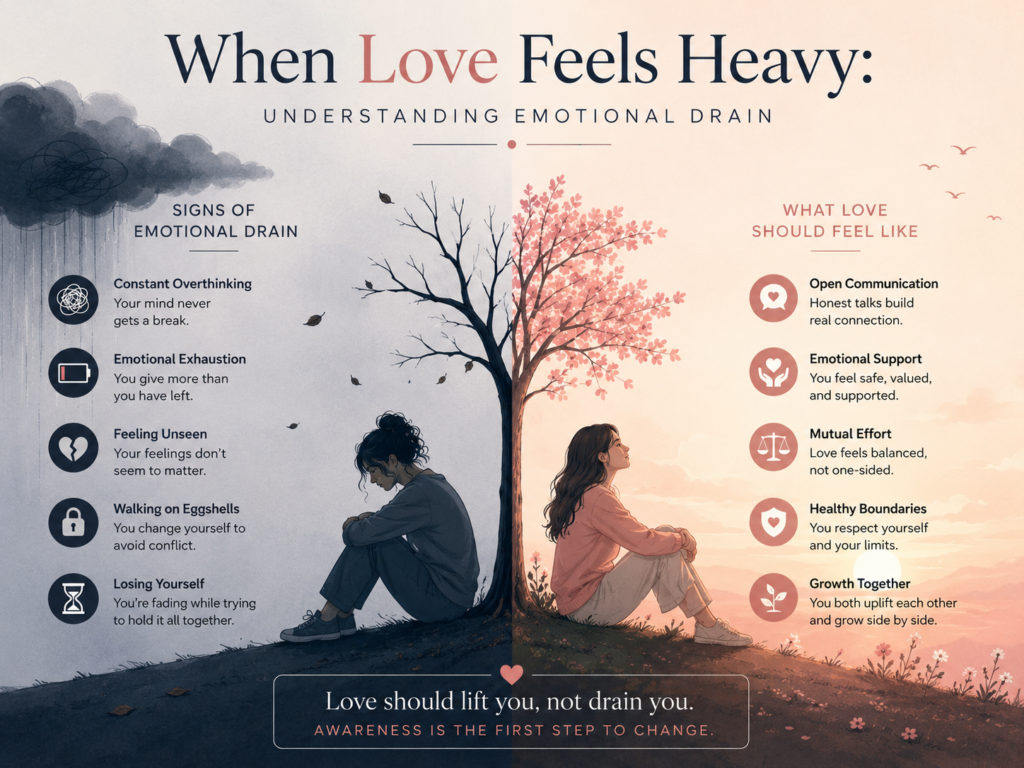
Love is supposed to feel supportive.
So why does it sometimes leave you feeling exhausted?
You care deeply.
You give generously.
You show up when people need you.
And yet, there are moments when the very relationships you cherish begin to feel heavy.
Not because you don’t love the people in your life.
But because somewhere along the way, love became mixed with responsibility, guilt, and emotional over-carrying.
And that’s a burden no relationship can sustain forever.
Not All Emotional Exhaustion Comes from Conflict
When people think about difficult relationships, they often imagine arguments, betrayal, or obvious dysfunction.
But emotional drain is rarely that obvious.
Sometimes it looks like:
- Always being the listener
- Constantly managing someone else’s emotions
- Feeling responsible for keeping the peace
- Being everyone’s source of support
- Never feeling like you can fully let your guard down
From the outside, the relationship may appear healthy.
Inside, however, you’re running on emotional fumes.
When Love Becomes Responsibility
Many of us learned early that love means taking care of people.
So we become the helper.
The fixer.
The one who notices everyone else’s needs before our own.
At first, it feels meaningful.
You feel needed. Appreciated. Important.
But over time, a subtle shift happens.
You stop relating to people through connection.
You start relating to them through responsibility.
And responsibility is much heavier to carry than love.
The Hidden Belief That Creates Emotional Drain
Often, emotional exhaustion is rooted in an unspoken belief:
“If I care about someone, I am responsible for how they feel.”
So you try to:
- Make everyone comfortable
- Prevent disappointment
- Solve problems that aren’t yours
- Protect people from difficult emotions
But no matter how much you give, it never feels like enough.
Because you are attempting an impossible task.
You cannot carry someone else’s emotional life for them.
Care and Carrying Are Not the Same Thing
This is where many loving people get stuck.
They confuse caring with carrying.
Caring says:
“I love you.”
“I support you.”
“I’m here for you.”
Carrying says:
“Your emotions are my responsibility.”
“Your happiness depends on me.”
“I must fix this for you.”
One creates a connection.
The other creates exhaustion.
Why Loving People Often Become Emotionally Drained
Because compassionate people naturally notice pain.
They see what’s unsaid.
They feel what’s beneath the surface.
They anticipate needs before they’re spoken.
These qualities are beautiful.
But without boundaries, empathy turns into over-functioning.
And over-functioning eventually leads to resentment, fatigue, and emotional depletion.
Not because you stopped loving.
Because you’ve been loving without replenishing.
When You Start Losing Yourself
Emotional drain becomes dangerous when you begin disappearing inside your relationships.
You may notice:
- You know what everyone else needs, but not what you need
- You feel guilty resting
- You struggle to say no
- You constantly prioritise others over yourself
- You feel emotionally responsible for everyone’s well-being
Slowly, your own inner world gets pushed to the side.
And the relationship starts costing you more than it’s giving you.
Love Should Not Require Self-Abandonment
Read that again.
Love should not require self-abandonment.
Healthy love allows space for:
- Boundaries
- Honesty
- Individual responsibility
- Emotional reciprocity
It does not require you to sacrifice your well-being to prove your devotion.
The strongest relationships are not built on one person carrying everything.
They’re built on shared responsibility.
What Emotional Balance Looks Like
Emotional balance is not about becoming less caring.
It’s learning the difference between support and sacrifice.
It looks like:
- Listening without absorbing
- Helping without rescuing
- Being present without taking ownership
- Caring without losing yourself
These shifts may feel uncomfortable at first.
Especially if you’ve spent years being the strong one.
But they create healthier relationships for everyone involved.
A Personal Realisation
There was a time when I believed that loving someone meant always being available.
I wanted to help. To support. To ease their struggles.
But over time, I noticed something.
The more I carried for others, the more disconnected I became from myself.
I was giving from obligation instead of overflow.
The shift happened when I realised:
Love is not measured by how much weight you carry.
It’s measured by how authentically you show up.
And authenticity requires boundaries.
If This Feels Familiar
If love feels heavy right now, pause before assuming something is wrong with the relationship.
Ask yourself:
Am I caring for this person?
Or am I carrying them?
Am I supporting them?
Or am I taking responsibility for what is theirs to navigate?
These questions can reveal where your energy is being lost.
A Closing Reflection
Love was never meant to feel like an endless obligation.
It was meant to nourish, connect, and strengthen.
If you are feeling emotionally drained, it may not be because you love too much.
It may be because you’ve been carrying too much.
And there is a difference.
A powerful one.
Because the moment you stop carrying what isn’t yours…
Love becomes lighter again.
Not because you care less.
Because you’ve finally learned how to care without losing yourself.
Powerful CTA
Today, pay attention to one relationship that feels emotionally heavy.
Ask yourself:
“What am I carrying here that doesn’t actually belong to me?”
Then practice putting down just one piece of that weight.
Not because you love less.
Because you deserve relationships where love feels supportive, not exhausting.


Social Profiles