
Written from the heart by Ruchi Rathor
Life Coach | Helping You Lead From Within
“The hardest person to trust after you’ve been hurt isn’t always someone else. Sometimes, it’s yourself.”
There comes a moment in healing when you realize something unexpected.
The biggest battle is no longer with the people who hurt you.
It’s with the voice inside your own head.
The one that whispers:
“What if I’m wrong?”
“What if I make the same mistake again?”
“Maybe I should ask someone else first.”
“Maybe I shouldn’t trust my instincts.”
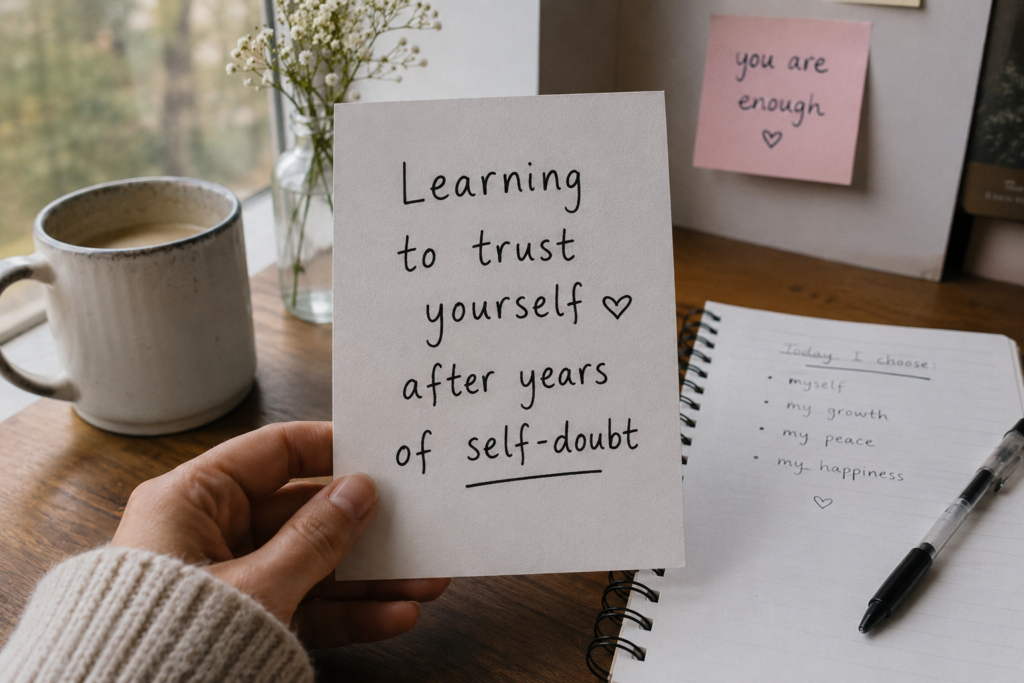
After years of doubting yourself, questioning your choices, and looking outside for reassurance, trusting yourself can feel unfamiliar—even frightening.
Not because you’ve lost your wisdom.
But because you’ve forgotten that it was always there.
Self-Doubt Doesn’t Appear Overnight
Very few people are born doubting themselves.
Self-doubt is usually learned.
Perhaps your feelings were constantly questioned.
Your decisions were criticized.
Your intuition was dismissed.
Or maybe every mistake was treated as proof that you weren’t capable enough.
Slowly, you stopped asking yourself what felt right.
You started asking everyone else.
Over time, confidence wasn’t what you lost.
Trust was.
When You Stop Trusting Yourself, You Start Borrowing Certainty from Others
This is one of the quietest forms of emotional exhaustion.
You struggle to make even simple decisions without seeking validation.
You replay conversations long after they’ve ended.
You ask five different people for advice, hoping someone will tell you what to do.
Not because you lack intelligence.
But because you’ve stopped believing your own voice is enough.
And the more you rely on external approval…
The quieter your inner wisdom becomes.
Self-Doubt Often Sounds Responsible
One of the reasons self-doubt is so difficult to recognize is that it disguises itself as caution.
It says:
“I’m just being careful.”
“I don’t want to make the wrong decision.”
“I’m just thinking things through.”
And while thoughtful reflection is healthy, chronic self-doubt is different.
It keeps you stuck.
You delay decisions.
You overthink opportunities.
You second-guess moments that once felt clear.
Eventually, life begins making decisions for you because fear has convinced you not to make them yourself.
Your Intuition Never Left
Here’s something I wish more people understood.
Your intuition doesn’t disappear because you’ve ignored it.
It simply becomes harder to hear beneath the noise of fear.
Fear is loud.
It demands certainty.
It predicts worst-case scenarios.
It searches for guarantees.
Intuition is different.
It speaks quietly.
It offers gentle knowing rather than loud certainty.
Learning to trust yourself isn’t about eliminating fear.
It’s about becoming familiar with your own inner voice again.
Trust Is Built Through Small Promises to Yourself
Many people believe self-trust arrives after one big, courageous decision.
It rarely works that way.
Self-trust grows through small moments.
You say you’ll rest and you do.
You set a boundary, and you honour it.
You make a decision, and instead of obsessing over whether it was perfect, you allow yourself to learn from it.
Every time you keep a promise to yourself, your mind receives a powerful message:
“I can rely on me.”
And that is where trust begins.
Stop Measuring Yourself by Your Past
One of the biggest reasons people struggle to trust themselves is that they keep using an old version of themselves as evidence.
They think:
“I trusted the wrong person before.”
“I ignored the red flags.”
“I made bad decisions.”
But here’s what healing teaches us.
You are not making today’s decisions with yesterday’s awareness.
You have learned.
You have grown.
You notice things now that you couldn’t see before.
Your past mistakes are not proof that you can’t trust yourself.
They are often the reason you can.
Confidence Is Not Knowing You’ll Never Be Wrong
Many people wait until they feel completely certain before they trust themselves.
But certainty is not the goal.
Because no one can predict every outcome.
Real self-trust sounds different.
It says:
“Even if this doesn’t work out… I’ll know how to respond.”
That’s confidence.
Not believing you’ll never fall.
Believing you’ll know how to get back up.
Healing Means Becoming Your Own Safe Place
There comes a point where healing is no longer about finding the right advice.
It’s about becoming someone whose own guidance feels trustworthy.
Someone who listens to themselves.
Honours their emotions.
Respect their limits.
Keeps their own promises.
Because when you become your own safe place…
Life stops feeling like something that constantly happens to you.
It becomes something you actively participate in.
A Personal Reflection
There was a season in my life when I questioned almost every decision I made.
I looked for reassurance everywhere.
I believed someone else must know better than I did.
But the more I searched outside myself…
The more disconnected I became from my own wisdom.
The turning point wasn’t when I suddenly became fearless.
It was when I started making small decisions without asking for permission.
When I began listening before doubting.
When I chose progress over perfect certainty.
Slowly, I realised something beautiful.
The voice I had been searching for wasn’t outside me.
It had been waiting patiently inside me all along.
A Closing Reflection
If you’ve spent years doubting yourself, be gentle.
You are not starting from nothing.
You are returning to someone you’ve always known.
Yourself.
Trust doesn’t grow because life becomes predictable.
It grows because you discover that no matter what life brings…
You can meet it.
And perhaps that’s the most powerful form of confidence there is.
Not believing you’ll always make the perfect choice.
But believing that whatever choice you make…
You will have the courage, the wisdom, and the resilience to walk yourself home again.
Your Gentle Practice This Week
The next time you find yourself asking everyone else what you should do…
Pause.
Before seeking another opinion, ask yourself:
“If fear wasn’t speaking… what would my inner wisdom say?”
Sit with the answer.
Trust it just a little more than you did yesterday.
Because every time you choose to believe your own voice…
You rebuild the relationship that matters most: the one you have with yourself. 🤍


Social Profiles