

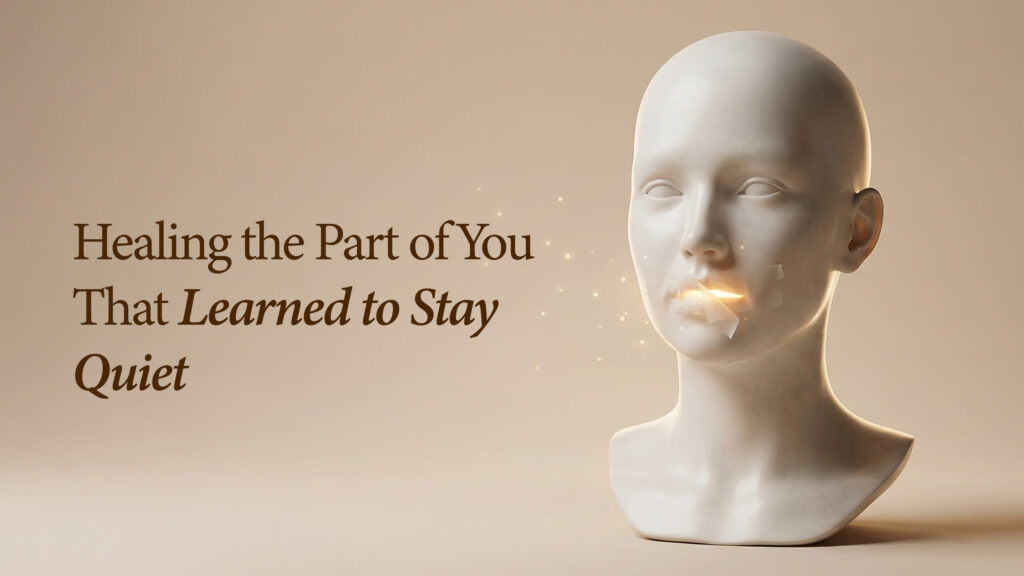
For a long time, I believed being quiet meant I was calm, composed, and in control. I thought silence was strength. Not reacting, not expressing, not speaking up made things easier for me and for everyone around me.
What I didn’t understand then was this:
Sometimes silence is not peace.
Sometimes it is protection.
And what looks calm on the outside
can often be an unspoken emotion on the inside.
Most of us did not choose silence consciously
At some point, staying quiet felt safer than speaking up.
Maybe your feelings were dismissed.
Maybe your voice was interrupted.
Maybe expressing yourself led to conflict, rejection, or misunderstanding.
So you adapted.
You learned to hold things in.
To think before speaking—then not speak at all.
To minimise your needs.
To avoid saying anything that might create discomfort.
Over time, silence stopped being a choice.
It became a pattern.
What silence can look like in adulthood?
The part of you that learned to stay quiet does not disappear. It shows up in subtle ways:
You hesitate before sharing your thoughts
You replay conversations in your mind instead of expressing them
You avoid difficult discussions
You say “it’s fine” when it isn’t
You feel misunderstood, but don’t correct it
On the surface, everything seems manageable.
But internally, there is pressure building.
Not because you feel too much, but because too much is left unspoken.
Silence protects, but it also disconnects
Staying quiet may have protected you at one point. It may have helped you avoid conflict, stay accepted, or keep things stable.
But what once protected you may now be limiting you.
Because when you silence yourself, you don’t just avoid discomfort.
You also lose connection.
Connection with others and connection with yourself.
You begin to feel unseen, even when you are present.
Not because others don’t care, but because they don’t fully know you.
Why speaking up feels difficult
If you are used to staying quiet, expressing yourself can feel unfamiliar.
You may worry:
Will this create conflict?
Will I be misunderstood?
Will this change how people see me?
Your body may respond with hesitation, tension, or doubt.
This is not a weakness.
It is conditioning.
Your system learned that silence was safer.
Now it needs time to learn something new.
Healing does not mean becoming loud
Healing the quiet part of you does not mean changing your personality. It does not mean you have to speak all the time or share everything with everyone.
It means permitting yourself to express when something matters.
It means recognising that your voice has value.
Not because it is perfect, but because it is yours.
What does healing this part look like
Healing begins in small moments.
It may look like:
Saying what you actually feel, even if it’s simple
Expressing a preference instead of adjusting automatically
Pausing before saying “it’s fine”
Allowing yourself to disagree respectfully
Sharing something honest with someone you trust
These are small shifts, but they create change.
Each time you choose expression over suppression, you build trust with yourself.
Listening to what you didn’t say
Before you can express yourself outwardly, it helps to understand what you’ve been holding in.
Ask yourself:
What do I often keep to myself?
Where do I feel unheard?
What do I wish I had said?
This is not about regret.
It is about awareness.
Awareness gives you a choice.
You are allowed to take up space
For many people, silence is tied to the belief that their needs are less important, that their voice is too much, or that speaking up will create problems.
But your voice is not a problem.
Your thoughts, your feelings, your perspective, they all deserve space.
You don’t have to earn the right to express yourself.
You already have it.
A personal realisation
There was a time when I thought staying quiet made me easier to be around. I avoided difficult conversations. I adjusted quickly. I told myself it was maturity.
But over time, I noticed a disconnect. I felt unheard, even in close relationships. Not because people didn’t care, but because I wasn’t sharing enough for them to understand me.
The shift began when I started speaking in small ways. Not perfectly. Not always comfortably. But honestly.
And that honesty changed how I related to myself.
If this feels familiar
If you recognise this pattern in yourself, there is nothing wrong with you. Silence was something you learned. And anything learned can be unlearned, slowly and gently.
You don’t have to change overnight.
You don’t have to say everything at once.
You just have to begin.
A closing reflection
Healing the part of you that learned to stay quiet is not about becoming someone else. It is about returning to yourself.
Your voice may feel unfamiliar right now.
But it is not gone.
It is waiting.
And every time you choose to use it, even in the smallest way, you come a little closer to being fully seen by others, and by yourself.


Social Profiles