
You’re not “overthinking.”
You’re not “too much.”
You’re just used to surviving in places where you never felt fully safe.
And now, even when life looks okay…
Your mind won’t slow down.
Your body won’t relax.
Your heart won’t fully trust.
Because survival doesn’t switch off just because circumstances change.
You Learned to Survive, Not to Feel Safe
Let’s be honest.
No one wakes up one day and chooses to live in constant alertness.
You learned it.
You learned to:
- Think ahead so nothing catches you off guard
- Stay prepared so you don’t feel helpless
- Read people carefully so you don’t get hurt
- Carry everything yourself so you don’t have to depend on anyone
And it worked.
It made you strong.
Capable.
Reliable.
But here’s the part no one tells you:
What helped you survive is now stopping you from feeling at peace.
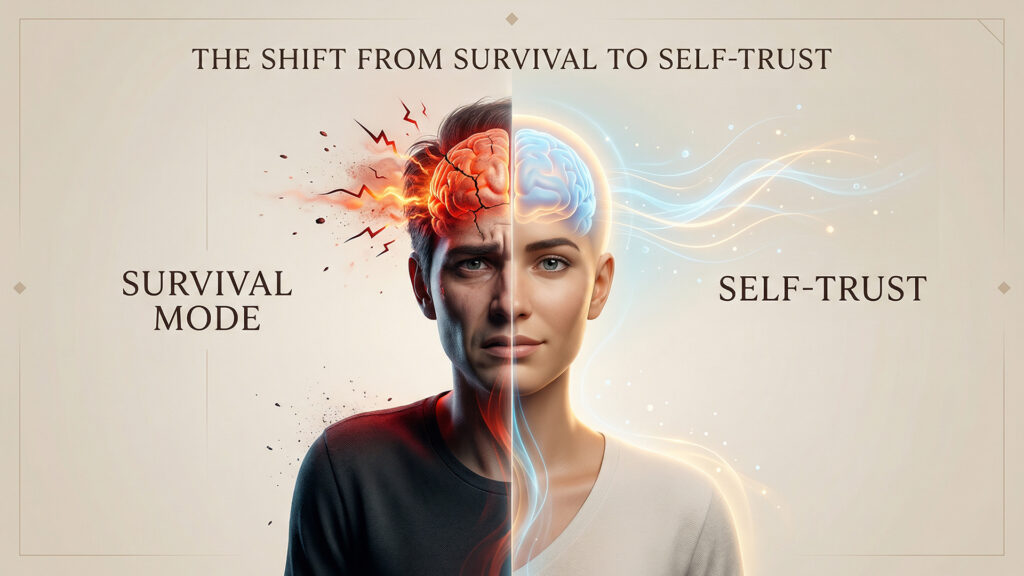
Survival Mode Doesn’t Look Like Chaos It Looks Like Control
From the outside, you look fine.
You handle things.
You stay composed.
You manage everything.
But inside?
You’re tired.
Because survival mode is not loud.
It’s subtle.
It looks like:
- Overthinking every decision
- Struggling to relax even when nothing is wrong
- Feeling responsible for everything
- Expecting something to go wrong, even in good moments
You’re not living freely.
You’re living cautiously.
The Problem Isn’t You, It’s the Pattern
You think:
“Why can’t I just relax?”
“Why do I always expect the worst?”
“Why is it so hard to trust?”
But this isn’t a personality flaw.
It’s a learned response.
Your system got used to being in control because control felt like safety.
So now, when things are calm… it feels unfamiliar.
And unfamiliar feels unsafe.
This Is Where Most People Get Stuck
You try to fix it by:
- Thinking more
- Planning more
- Controlling more
But that only strengthens the cycle.
Because here’s the truth:
You cannot think your way out of survival mode.
You have to feel your way into safety.
Self-Trust Begins Where Control Ends
Let’s shift something.
What if you didn’t have to predict everything to be okay?
What if you didn’t need all the answers before taking a step?
What if safety didn’t come from control… but from trusting yourself to handle whatever comes?
That’s self-trust.
Not certainty.
Not perfection.
Just the quiet belief:
“I will figure it out.”
Why Letting Go Feels So Hard
Because control has been your safety net.
Without it, you may feel:
- Restless
- Anxious
- Exposed
You may feel like something is missing.
But what’s actually happening is this:
You’re stepping out of survival… and your system doesn’t know this version of you yet.
So it resists.
Not because it’s wrong.
But because it’s new.
The Shift Happens in Small Moments
You don’t move into self-trust all at once.
It happens slowly.
When you:
- Decide without overanalysing it
- Let something unfold without controlling it
- Rest without planning the next move
- Trust your first instinct instead of doubting it
These moments seem small.
But they send a powerful message to your system:
“I am safe enough to let go.”
A Personal Realisation
There was a time when I thought my need to stay in control made me strong.
I was always prepared. Always thinking ahead.
But I was never at ease.
Even in calm moments, I was waiting for something to go wrong.
The shift didn’t come when life became perfect.
It came when I stopped needing it to be.
When I allowed things to unfold… and trusted myself to respond.
That’s when I realised:
Peace doesn’t come from control.
It comes from trust.
You don’t need to stay in survival mode to stay safe.
You don’t need to control everything to be okay.
You are allowed to feel at ease.
You are allowed to trust yourself.
If you’ve been living in survival mode, start here:
Pause.
Take a breath.
And ask yourself:
“What would I do right now if I trusted myself… even a little?”
Then take that step.
Not perfectly.
Not fearlessly.
But willingly.
Because the moment you stop trying to control everything… You finally start coming home to yourself. 🤍


Social Profiles